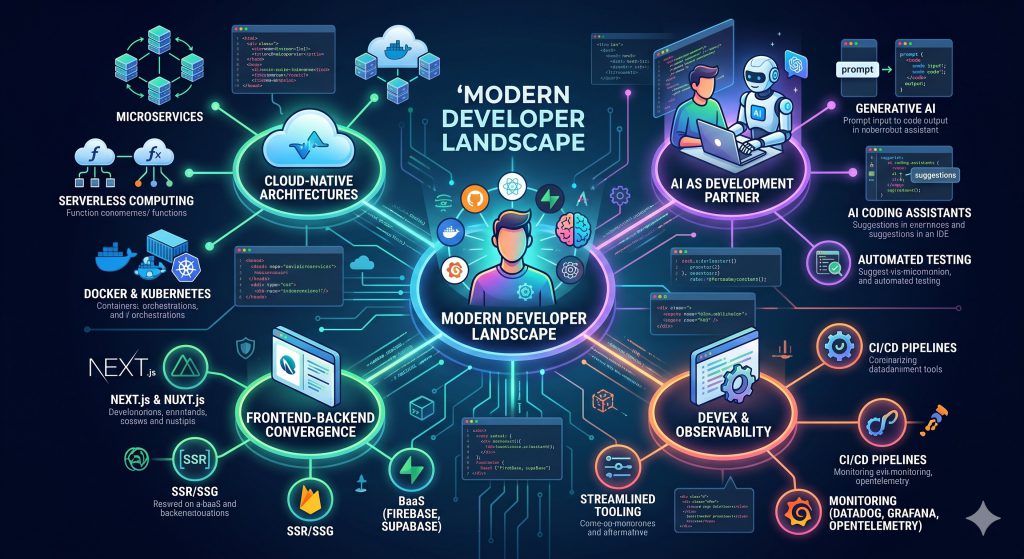
The definition of a “software developer” is in a constant state of flux. While core principles of logic and problem-solving remain, the tools, workflows, and architectures we use are evolving at breakneck speed.
To stay relevant in 2024 and beyond, developers are moving beyond legacy systems and adopting technologies that prioritize speed, scalability, and enhanced user experiences. Here is a look at the key trends and technologies defining the modern development landscape.
1. The Era of Cloud-Native and Serverless Architectures
We are moving definitively past the age of managing physical servers. Modern applications are “cloud-native,” designed specifically to thrive in distributed, dynamic cloud environments.
- Microservices: Breaking large, monolithic applications into smaller, independent services that communicate via APIs. This allows for faster development cycles and easier scaling of specific components.
- Serverless Computing (FaaS): Technologies like AWS Lambda and Google Cloud Functions allow developers to write code without managing the underlying infrastructure. You only pay for the exact compute time your code consumes, making it highly efficient for event-driven tasks.
2. The Standardization of Containerization and Orchestration
If microservices are the what, containers are the how. Containerization provides a lightweight, consistent environment for applications to run, regardless of where they are deployed.
- Docker: The standard for packaging applications and their dependencies.
- Kubernetes (K8s): The indispensable tool for automating deployment, scaling, and management of containerized applications. K8s is now the backbone of modern DevOps.
3. AI as a Development Partner (Not a Replacement)
Generative AI is fundamentally changing how developers write, debug, and test code. Rather than replacing engineers, AI is automating the mundane aspects of development.
- AI Coding Assistants: Tools like GitHub Copilot, ChatGPT, and specialized coding models are used for real-time code suggestions, boilerplate generation, and instant debugging assistance.
- Automated Testing: AI is improving the quality of software by generating test cases and predicting potential areas of application failure.
4. The Rise of “Frontend” Backends
The traditional line between backend and frontend is blurring. Frontend developers are taking on more full-stack responsibilities thanks to powerful frameworks and deployment platforms.
- Next.js and Nuxt.js: These frameworks simplify Server-Side Rendering (SSR) and Static Site Generation (SSG), making frontend applications highly performant and SEO-friendly.
- Backend-as-a-Service (BaaS): Platforms like Firebase and Supabase provide authentication, databases, and storage via simple APIs, allowing frontend developers to build complex applications without needing a traditional backend team.
5. Prioritizing Developer Experience (DevEx)
It’s no longer enough just to build a tool; the tool must be easy and efficient to use. DevEx is now a competitive advantage for technology platforms.
- Integrated Tooling: Companies are investing in better command-line interfaces (CLIs), comprehensive documentation, and streamlined onboarding processes.
- Observable Systems: Tools like Datadog and Grafana (using OpenTelemetry) are essential for understanding application performance and quickly diagnosing issues in complex, distributed systems.
Looking Ahead
The modern developer trends are defined by abstraction—moving away from infrastructure management and toward high-value application logic. By embracing cloud-native technologies, AI collaboration, and a relentless focus on developer experience, software engineers are equipping themselves to build the robust, scalable applications that the digital economy demands.
Related Blogs